CIFF Data Intelligence
Turning global impact data into decisions.
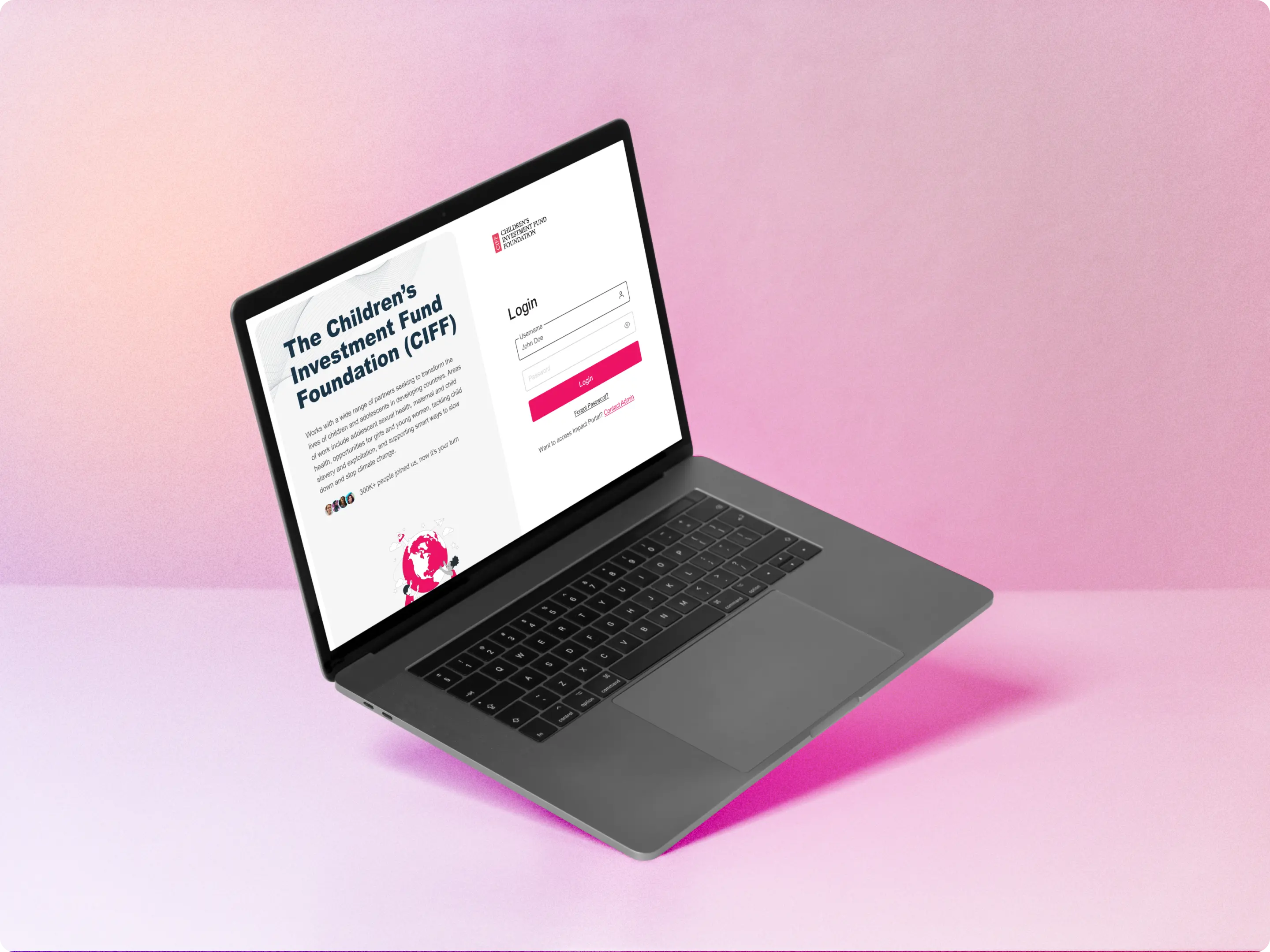
One of the world's largest philanthropies, data-rich, insight-poor.
The Children's Investment Fund Foundation (CIFF) operates across child health, education, climate change, and gender equality initiatives on every inhabited continent. Their programs involve hundreds of partner governments, NGOs, and field organisations, each generating data on vaccination rates, educational outcomes, malnutrition indicators, financial disbursements, and carbon offset metrics.
Despite the richness of this data, CIFF teams were consistently blocked by the same wall: the data was fragmented across siloed systems and visualised inconsistently. Reports arrived as dense tables or static slide decks. Understanding the story behind the numbers required hours of manual interpretation, hours that decision-makers at board level simply didn't have.
“Leadership could access data, but understanding the story behind it required hours of manual interpretation, a bottleneck at the exact moment decisions needed to be made.”
Discovery finding, CIFF Data Intelligence PlatformBeyond visualisation, building a data intelligence ecosystem.
The brief pushed further than a reporting tool. CIFF wanted a system capable of supporting strategic conversations at the board level and operational monitoring at the field level, simultaneously, from the same data. That's a design tension between synthesis and granularity that most dashboards resolve by picking one side. We needed both.
Fragmented Data Sources
Visibility Gaps
Accessibility Barriers
Resource Allocation Risk
The right chart only exists after the right taxonomy.
Before a single visualisation was designed, every dataset was classified by its function and the decision type it informed. This taxonomy became the foundation for matching data to the most effective visual model, and ensured consistency across the entire platform.
Three decision layers. One unified system.
The platform was structured around three distinct decision-making contexts, each with tailored interfaces and data granularity. The board needed synthesis. Program managers needed evaluation. Field teams needed operational clarity. Designing for all three simultaneously, without creating three separate products, was the core challenge.
Level 01, Executive Oversight
Level 02, Program Evaluation
Level 03, Operational Monitoring
Data architecture first. Aesthetics last.
The most common failure in dashboard design is jumping to visual styling before establishing what the data actually means and how it connects. We started where the problem lived, in the data relationships, and built outward from there.
Discovery & Data Mapping
Visualization Strategy
UX & Design System
Four modules. One coherent intelligence layer.
Each module was purpose-built for a distinct type of organisational question while drawing from the same underlying data architecture and visual grammar. Consistency of language across modules meant users only had to learn the system once.
Funding Insights
Visualised how financial commitments translated into on-ground progress through layered Sankey flows combined with budget vs. expenditure line charts. Every funding pathway made visible, where money entered, how it moved, and what it produced.
Impact Performance
Tracked longitudinal progress of health, education, and climate programs through multi-series trend charts supported by colour-coded milestones. Teams could spot early deviations in project outcomes and course-correct before targets were missed.
Regional Comparison
Highlighted performance disparities across countries and regions through comparative dashboards with normalised bar charts and indexed performance lines. Underperforming geographies surfaced automatically.
Sustainability & Climate
Monitored projects contributing to climate adaptation and emissions reduction through combined area charts, carbon offset trackers, and interactive geographic overlays. Enabled CIFF to present measurable environmental progress to global partners.
Designed for a global organisation, every device, every literacy level.
A data platform that only works for data analysts has solved the wrong problem. CIFF's operational network spans field teams in low-connectivity regions, program managers unfamiliar with data tools, and board members who need instant clarity without training.
Offline Access
Key dashboard summaries were cached for low-connectivity environments. Field teams could access the most recent data snapshots without live network access, mirroring the offline-first principle applied in field data collection.
Screen Reader Support
Every interactive chart included semantic labelling, data was accessible as structured text, not just visual output. Charts communicated through description, not just colour and shape.
Localisation
Number formats and date conventions adjusted dynamically for regional users. A percentage read differently in the US than in West Africa; the platform handled these conventions automatically.
Embedded Training Resources
Visual legends and short tutorials embedded directly within the dashboard interface. Non-technical program managers could understand what a chart was telling them without leaving the page.
The results that justified every design decision.
“Clarity is not just aesthetic, it is ethical. In the context of child welfare and humanitarian impact, clear data visualization is not a luxury; it is a responsibility.”
Project design principle, CIFF Data Intelligence PlatformWhat designing for humanitarian data teaches you.
Visualisation is a shared language
In multi-stakeholder environments, a well-designed chart eliminates translation gaps between analysts, decision-makers, and implementers. The chart must communicate without an interpreter present.
Empathy shapes data design
Understanding who uses the data, and under what pressure, matters as much as the data itself. Board dashboards prioritised speed and synthesis. Field dashboards prioritised simplicity and legibility.
Progressive detail builds trust
Revealing data progressively rather than all at once encouraged curiosity without overwhelming first-time users. The ability to choose depth, not have it imposed, increased platform adoption significantly.
Collaboration elevates credibility
Every visual choice was validated against CIFF's internal data team. This alignment strengthened both the system's accuracy and the organisation's confidence in presenting the platform externally.
Design systems reduce future overhead
By establishing a reusable visual framework, CIFF can extend the platform to new programs and metrics without starting from zero each time. The design investment compounds over every future initiative.
Taxonomy precedes aesthetics
Classifying data by type and decision function before choosing any visualisation was the single highest-leverage step. The right chart cannot be chosen until you know precisely what the data is for.
CIFF had rich data on child health, education, and climate across dozens of countries. The data was trapped in silos, spreadsheets, and static PowerPoint decks. We built the visualization framework that turned it into a living intelligence system, from boardroom to field office.