Huestar
The colour tool designers actually needed, built from scratch.
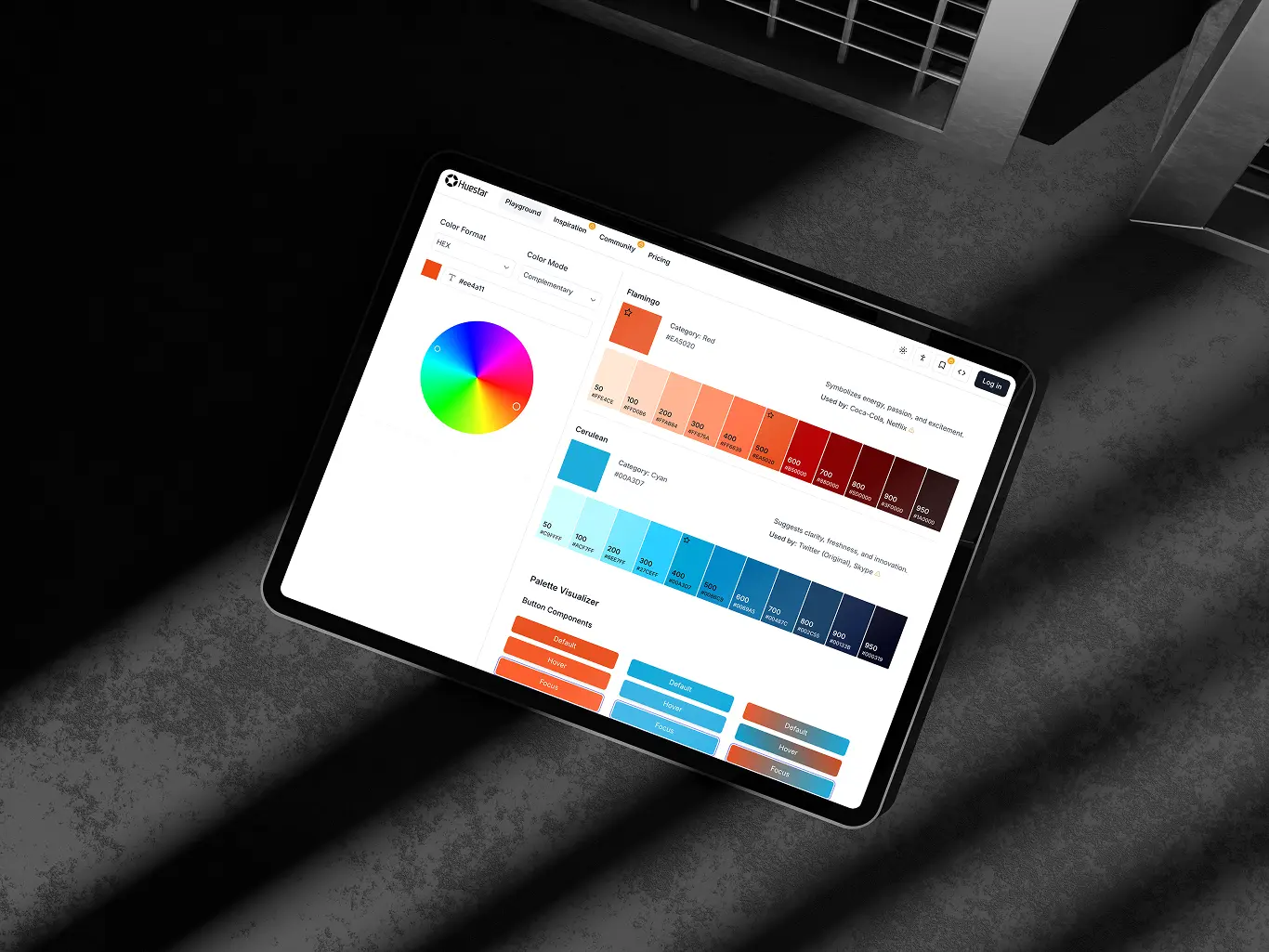
Designers were juggling 8–12 tools to pick a colour.
Fragmented Tooling
Accessibility Blind Spot
Constrained Algorithms
Poor Export Workflow
Not a single pixel drawn before 15 interviews were done.
Before opening any design tool, three rounds of research shaped every subsequent decision, from the feature set to the information architecture to the export formats. The product was built from documented pain, not assumed frustration.
Stakeholder Interviews
Contextual Inquiry
Competitive Audit
“The critical discovery: 8% of men have colour vision deficiency, and not a single major colour tool implemented proper colorblindness simulation. That was the gap Huestar was built to close.”
Research finding, Huestar user research phaseFour distinct users. One tool that serves them all.
Pulkit, Agency Designer
Shikha, Freelancer
Ishika, Accessibility Advocate
Maitrey, Developer
A designer building a full-stack app with AI.
The designer behind Huestar is not a developer. The entire production-ready application was built through a structured collaboration with AI, not as a shortcut, but as a genuine partnership where each brought something the other couldn't.
Discover the real frustrations
15 designer interviews and 3 contextual observation sessions mapped the colourful chaos of real projects, every tool-switching moment documented.
Decode what matters most
Every story, screenshot, and badly exported hex code distilled into hard design goals: streamlined discovery, authentic brand palettes, and accessibility baked in from the first click.
Dream wild, invent solutions
Technical discussions about OKLCH colour space, accessibility algorithms, and brand psychology databases running in parallel with design exploration.
Build fast, break fast
Early versions were real, broken, beautiful experiments. Designers tested prototypes on production projects. The architecture (React 18 + TypeScript + Vite) emerged from solving user problems.
Iterate in real time
Every mistake became fuel. Feedback sessions turned into improvement sprints, AI solving bugs, new features launching at speed, the design system evolving.
Launch, listen, level up
Launch was a starting line, not a finish. Every click, swipe, and survey drove updates, the product continuing to evolve post-launch.
Four pillars that addressed every pain point in the research.
OKLCH Colour Spectrum Generator
OKLCH matches human colour perception more accurately than RGB or HSL, producing spectrums that feel harmonious because they are mathematically harmonious, perceptually uniform lightness scaling, precise hue relationships, and chroma adjustments that maintain visual balance at any point in the scale.
Revolutionary Accessibility Integration
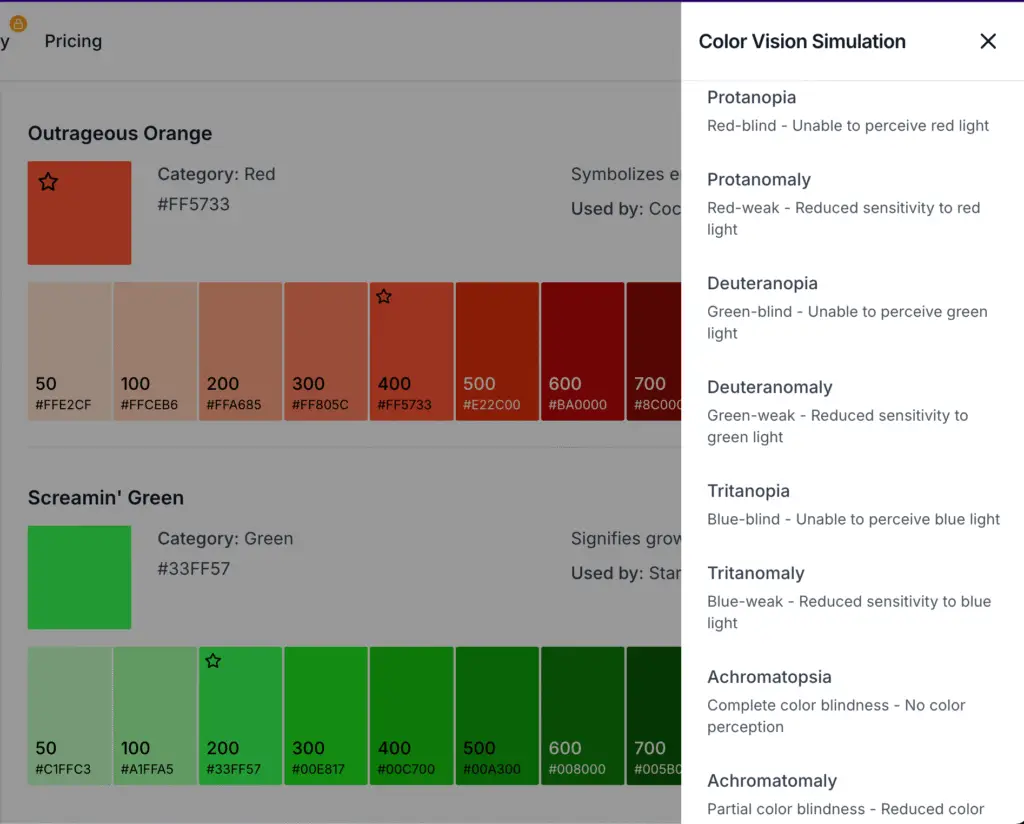
Accessibility wasn't added as a panel, it was architected into the entire user experience from day one. Real-time WCAG compliance checks ran on every colour combination. Colorblindness simulation covered all three major types. And critically, Huestar actively suggested palette adjustments. No other tool offered this.
Brand Colour Psychology Engine
A comprehensive database mapping 50+ famous brand palettes to their psychological associations and colour theory underpinnings. Inspiration grounded in evidence rather than aesthetic guessing.
Professional Export System
Eight formats with proper naming conventions and format-specific optimisation, including Tailwind 4 (rare at launch), OKLCH (which most tools couldn't produce), and SCSS Variables with full token documentation.
The feature no competitor had touched.
Colorblindness simulation was the clearest gap in the market. Each of the three major types of colour vision deficiency produces a fundamentally different experience of colour, requiring separate simulation algorithms and separate accessibility recommendations.
Protanopia
Red-blind · ~1% of men · Reds appear olive/brown. Huestar simulates the full spectrum shift and suggests specific palette swaps.
Deuteranopia
Green-blind · ~1% of men · Most common CVD type. Real-time simulation shows how the entire palette reads under this condition.
Tritanopia
Blue-blind · ~0.01% of people · Blues become green. Rarest CVD type, and the one most overlooked by tools that offer partial simulation only.
Beyond simulation, Huestar actively analyses palettes under each CVD type and surfaces specific recommendations, swap this shade, increase this contrast ratio, avoid this combination, turning a passive visualisation into an actionable accessibility workflow.
Eight formats. Zero manual conversion.
Tailwind 4
OKLCH-native variables for the new Tailwind. Rare at launch, no other colour tool supported it.
Tailwind 3
Standard config.js format with full named scale, ready to paste.
OKLCH
Perceptually uniform values, the most technically precise format available.
CSS Variables
Native custom properties with semantic naming for any web project.
SCSS Variables
Complete SCSS token set with documentation comments included.
HSL
Human-readable format preferred for design system token naming.
Hex
Universal fallback, widely compatible for any tool or handoff.
RGB
Legacy support for older codebases and tools requiring decimal values.
Zero manual conversion
Copy-ready code in 8 formats including Tailwind 4 and OKLCH — formats no other colour tool supported at launch. Designers screenshotting palettes to hand off to developers became a thing of the past.
Not just more features, a different philosophy.
What shipped at the end of 11 weeks.
“A designer built a production-ready full-stack application in 11 weeks, not by learning to code, but by learning to collaborate with AI precisely enough that the code that emerged was exactly what the user research demanded.”
Project summary, HuestarWhat building a product from scratch actually teaches.
Research is the highest-leverage activity
Every feature in Huestar traces back to a specific interview moment or observed behaviour. The 11 weeks of build time were efficient because the preceding research meant there was no guesswork about what to build.
AI can bridge creative vision and technical execution
The project proved that a non-developer with precise design thinking can build production-quality software through AI collaboration, provided the human brings the strategic clarity that AI cannot generate.
Accessibility is a competitive differentiator
The decision to centre accessibility in Huestar's architecture, not add it later, was both ethically right and commercially sharp. Designing for inclusion doesn't cost you the mainstream market. It expands it.
Competitive advantage is born from methodology
Huestar's differentiation came from the research process, not from guessing what features were missing. Systematic competitive analysis revealed the OKLCH and colorblindness gaps.
Designers were juggling 8–12 tools just to select a colour palette. No single tool offered accessibility checks, colorblindness simulation, OKLCH spectrum generation, and developer-ready exports together. Huestar was built to be that one tool, by a designer, with AI, from real user frustration.